Krishna Janmashtami celebrates the birth of Krishna, traditionally regarded as the 8th Avatar of Lord Vishnu — the festival typically falls sometime between mid-August and mid-September. The celebration honors Krishna’s divine presence in the face of tyranny, the triumph of good over evil, and the playful, compassionate, and timeless wisdom he came to embody.
Krishna is known and loved for many things, but one of the most enduring is his role in the Bhagavad Gita, the sacred dialogue between Lord Krishna and the great warrior, Prince Arjuna just before the great Battle of Kurukshetra. Part of the larger Mahabharata, the Gita has endured for thousands of years as one of the world’s great spiritual and philosophical texts.
And at the center of that conversation is an image that almost everyone has seen at least once, Lord Krishna standing at the front of a chariot, reins in hand, with Arjuna beside him, four horses charging forward into the space between two armies. I grew up seeing this image everywhere, in my parents house, on calendars, family homes, in temple art, cafes, on the walls of Indian restaurants you’ve probably eaten in. It’s one of the most reproduced images in the world.
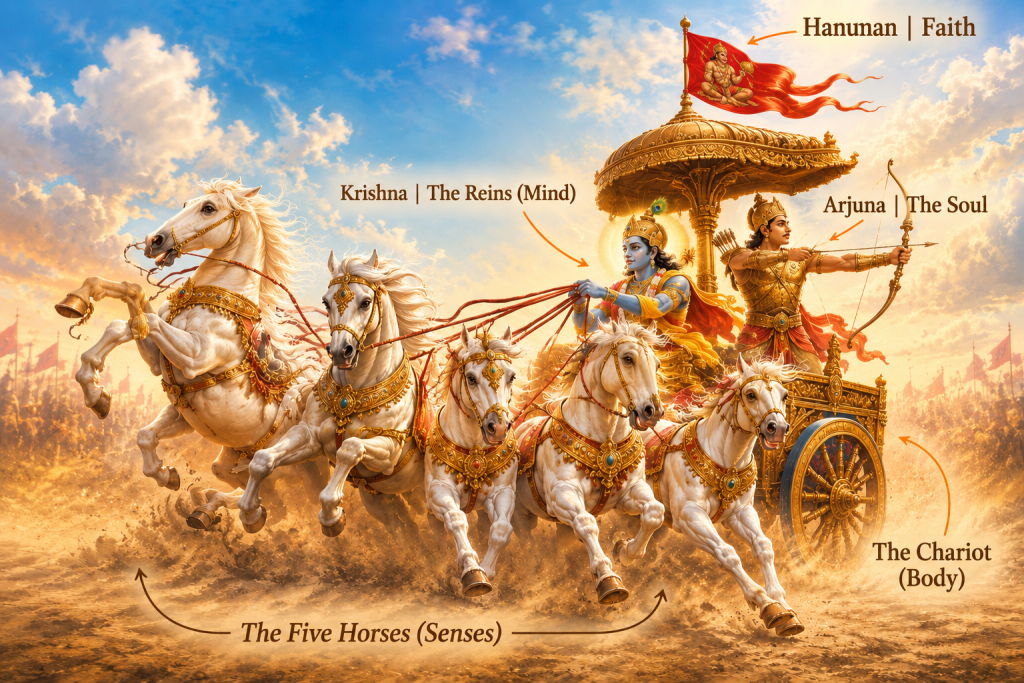
And for most of my life, I had no real idea what it fully meant. It wasn’t until much later, well into adulthood, that I began to understand the chariot in the Mahabharata — the ancient Indian epic that tells the story surrounding the great Kurukshetra war — isn’t really about a battle at all. It’s a metaphor for the human condition itself.
The chariot is the body. The five horses are the senses. The reins are the mind. Arjuna is the individual soul. Krishna is the inner wisdom that’s supposed to be doing the driving.
Once you see it that way, you can’t unsee it. It’s not a scene from ancient India, it’s a snapshot of what’s happening inside you right now, today, while you read this.
The Chariot: A Body You’re Riding In, Not a Body You Are
Start with the chariot itself. In the metaphor, the body is the vehicle, the thing carrying you through the world, not the thing doing the deciding. That distinction matters more than it sounds like it should. So much of modern life treats the body as the main character: how it looks, how fast it moves, how tired it is. The Gita quietly disagrees. The chariot is important, you can’t get anywhere without it, but it is not meant to steer itself.
The Five Horses: Your Senses, Off to the Races
The five horses pulling the chariot are the five senses, sight, hearing, smell, taste, touch. And horses, left completely to their own instincts, don’t head somewhere on purpose. They bolt toward whatever’s shiny, loud, or immediately rewarding.
That’s not a knock on the senses. You need them; a chariot with no horses goes nowhere. The problem shows up when the horses take over the driving, when a craving, a scroll, a compliment, or a grudge gets to decide where the whole chariot goes next.
A few places you’ve probably met your own horses lately:
- Reaching for your phone before your eyes are even fully open
- Saying yes to something because it sounded good in the moment, not because you actually wanted it
- Letting one sharp comment steer your entire afternoon
The Reins: Your Mind, Doing More Work Than You Realize
Between the horses and the driver sit the reins, and in this metaphor, the reins are the mind. Not the soul, not the wisdom, just the mind. The instrument that translates a decision into direction.
This is the part people skip past, and it’s the part I find most useful. The mind isn’t villain or hero here, it’s infrastructure. Loose reins don’t mean the horses are bad; they mean nothing is currently connecting the horses to the one who can actually see the road. A mind left slack tends to hand control straight back to the senses. A mind held with steady, aware attention becomes the very thing that lets wisdom reach the horses at all.
There’s a modern image that captures this well: you don’t drive a car with your foot pressed permanently on the brake. But a car with no brakes at all is a disaster waiting to happen. The reins work the same way. The goal isn’t constant restraint of every sense and impulse. It’s having brakes available for the moments that actually call for them, an unkind reply, an impulsive purchase, a decision made from exhaustion rather than clarity, and knowing how to use them when it counts.
The Roads, the Wheels, and Where You’re Actually Headed
The metaphor doesn’t stop at the horses and reins. The roads this chariot travels represent the objects of your senses and your desires, everything out in the world, and everything already stored in memory, quietly steering your instincts before you’ve even consciously chosen a direction. And the wheels carrying the whole thing forward are described as right effort, not talent, not luck, just the willingness to keep turning, day after day.
All of it is headed somewhere specific, too. The destination is not about just getting through the day. It’s described as perfection, self-realization, arriving fully at your own truest nature.
Arjuna and Krishna: The Soul and the Wisdom It Forgets It Has
Arjuna is the one riding in the chariot, the individual soul, present and along for the journey, but not automatically in charge. And right before the most famous battle in Indian literature, Arjuna freezes. He looks at the field, at people he loves standing on the opposing side, and he wants to put the whole thing down and walk away.
In many ways, Arjuna is having what we might now call an existential crisis. He’s overwhelmed, confused, and ready to walk away.Everything he thought he understood about duty, morality, family, and the path he was supposed to follow suddenly collides in one impossible moment. He doesn’t simply question whether he wants to fight; he questions what the right thing even is anymore.
Most of us will never stand between two armies, but the questions underneath his crisis are surprisingly familiar: What am I doing? Is this still the right path for me? What actually matters here? There are moments in life when the identities, ambitions, responsibilities, or beliefs that once gave us direction stop providing clear answers. And that is exactly where the Gita begins — not with someone who has life figured out, but with someone who doesn’t.
That moment, not the battle itself, is the real heart of the story. It’s the universal experience of standing at the edge of something that matters and feeling completely unequal to it. And it’s exactly the moment Krishna, representing the deeper, wiser part of Arjuna’s own being, steps in, not to fight for him, but to remind him who’s actually in the chariot with him.
Krishna doesn’t take the reins away from Arjuna’s fear by force. He talks him back into remembering there’s a wiser seat available to him, one he’d simply forgotten to sit in.
That’s the piece that changed how I read the whole image. Krishna was never separate from Arjuna in some far-off, unreachable way. Krishna is the part of Arjuna, the part of any of us, that already knows what to do, sitting quietly next to the part of us that’s panicking. The chariot only moves well when both are actually in conversation.
Horse-Led or Wisdom-Led
You don’t need a war to end up horse-led instead of wisdom-led. It happens in traffic, in group chats, in an endless argument with your significant other, in the ten minutes after a hard email lands. The senses fire off a reaction, the mind either tightens the reins or drops them entirely, and the soul either gets to weigh in, or gets dragged along for the ride.
And sometimes what pulls us off course isn’t an obvious craving or impulse at all. It’s our attachment to a particular outcome — needing the relationship to work, the opportunity to happen, the plan to unfold exactly as imagined. One of the Gita’s most enduring teachings is that we are responsible for how we act, but we cannot completely control what our actions produce. When our peace depends entirely on the result, we hand something outside ourselves an extraordinary amount of power over our inner state.
The whole point of the image is not “ignore your senses” or “suppress your body.” It’s “remember who’s holding the reins.” Horses are meant to run. Bodies are meant to feel. The invitation is just to keep the wisdom seat occupied while all of that is happening, not to empty the chariot, but to stop letting it drive itself.
The Battlefield Is Not Outside US
The detail I find almost impossible to un-know once you’ve seen it: Kurukshetra, the battlefield where the entire Bhagavad Gita takes place, isn’t just a location in a historical epic. It’s described as the field of our own mind. The two armies facing off, the Kauravas and the Pandavas, represent something far more personal than an ancient royal feud. One side carries what’s called your demonic nature; the other, your divine nature. And this wasn’t a battle that happened once, a long time ago. It’s described as ongoing, fought inside every one of us, every single day.
Krishna, in this reading, is always found on the side of dharma, “righteous duty” or “the path of truth,” not religious rule-following, but a simpler idea: what’s actually real and sustaining, versus what only feels real in the moment and quietly undermines you. If you want that wiser guidance riding with you, the invitation is to cultivate the qualities dharma is made of, honesty, restraint, courage, patience, because that’s where you’ll find it waiting.
In this tradition, the practice of retraining your inner charioteer, again and again, has a name : sadhana (a daily spiritual practice of discipline and self- mastery). It’s not glamorous work, but there is something quietly sexy about that kind of self-mastery — being able to feel deeply, desire freely, and experience life fully without being ruled by every impulse that passes through you. It’s not about becoming rigid or overly controlled. It’s the daily, repeated practice of knowing when to let the horses run and when to hand the reins back to the wiser seat.
The Bhagavad Gita reminds us to call upon and trust Divine Guidance as we move toward greater peace and enlightenment. And although the battles within are ultimately ours to face, we are never truly alone. The Divine remains beside us, our inner charioteer — ‘Krishna’ (Atman or Higher Self ) guiding us as we learn to face and overcome the inner forces that can pull us away from our true Self.
One rein at a time. 💛
REFLECTION
Wherever you are right now, let’s take a moment to reflect:
- Right now, in this season of your life, who’s actually holding your reins, your senses, your fear, or your wisdom?
- Where have you been treating the chariot (your body, your reactions) as if it were the whole of who you are?
- What would it look like to let the wisest, calmest part of you take the reins for just the next hour?
If something here shifted the way you look at things, I’d love to have you along for the journey. Join the newsletter for more honest reflections like this one, and if you’re curious about working together or exploring the support I offer, you’re welcome to find out more. 💛