STRENGTH · DEVOTION · TRANSFORMATION · GRACE
The Wisdom and Power of Goddess Durga
What the Goddess Reveals — On Courage, Self-Mastery & the Quiet Warrior Within
Imagine being given the name of one of Hinduism’s fiercest goddesses and then realizing you’re meant to grow into it.
At the end of my Yoga Teacher Training, our spiritual teacher gave us a spiritual name, mine was: NavaDurga. In the yogic tradition, a spiritual name isn’t simply a new name—it’s an invitation. It reflects qualities your teachers have quietly witnessed and the potential they believe lives within you. When I heard ‘NavaDurga,’ I felt equal parts honored and intimidated. It wasn’t a title to wear. It was a path to walk.
Who is Durga?
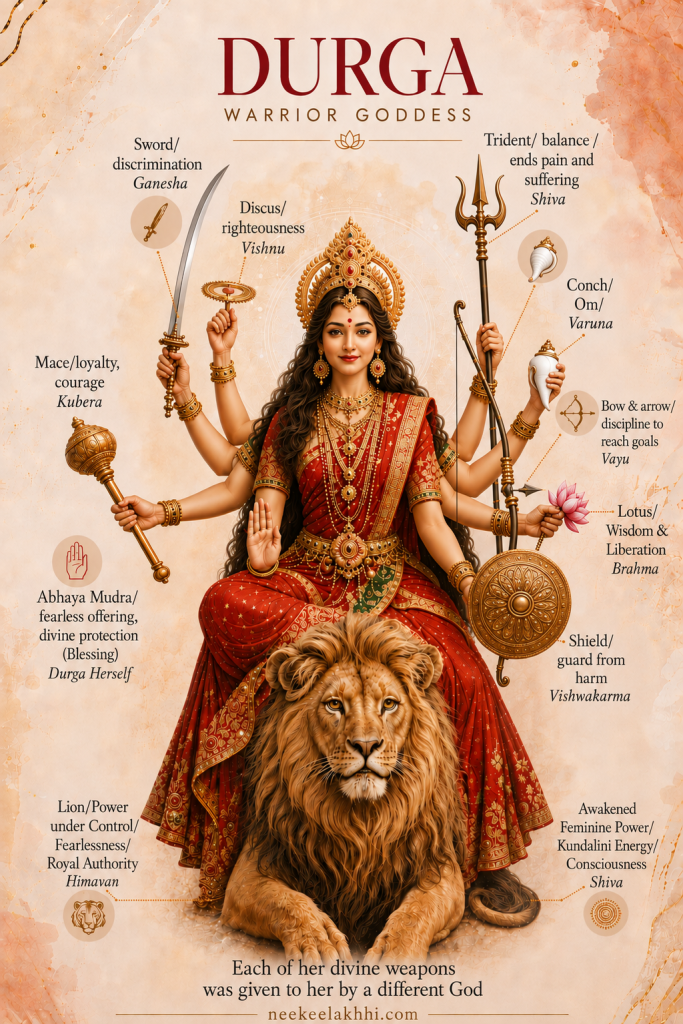
When you look at a Durga murti (a sacred image or representation of the goddess), it’s hard not to be drawn in by her commanding presence—her many arms carrying symbolic weapons, her expression composed and serene, even as she sits upon a fierce lion. Durga embodies courage, compassion, protection, unwavering inner strength, and the nurturing power of the Divine Mother. According to the Devi Mahatmya, when the buffalo demon Mahishasura became too powerful for any one deity to defeat, the Gods did something extraordinary. They stopped competing and combined their power. From that collective light, Durga emerged.
In many Hindu traditions, she is closely associated with Parvati, the consort of Lord Shiva. Shiva and Shakti are often understood as inseparable principles—consciousness and the dynamic energy through which consciousness manifests. Durga, as an expression of Shakti, embodies that active divine power. She is not simply a goddess who possesses power; she is an embodiment of power itself.
Did You Know?
- Durga’s name is often translated as ‘the invincible one’ or ‘the remover of difficulties and fear’
- In the Devi Mahatmya, she emerges from the combined divine energies of the Gods
- Every weapon she carries was gifted by a different deity, symbolizing that wisdom can come from many teachers
- Her many arms aren’t meant to be taken literally. They symbolize our ability to hold many roles, strengths and responsibilities with grace
- She rides a lion not to dominate it, but to master it. The lion represents royalty, courage, and power
The Symbolism Behind Her Weapons
One of my favorite parts of Durga’s story is that every object she carries has meaning.
- Sword — sharp intellect; discernment; cutting through illusion / ignorance
- Trident (Trishul) — harmony of body, mind and spirit; overcoming the 3 qualities of nature (sattva, rajas, & tamas)
- Lotus — remaining pure even while life feels messy ; spiritual awakening
- Bow and Arrow — focus and purposeful action
- Conch — awakening and truth ; cosmic sound “OM” (divine energy)
- Lion — “King of the Forest” ; riding the Lion shows that Goddess Durga has complete control over power, the human ego, and untamed desires
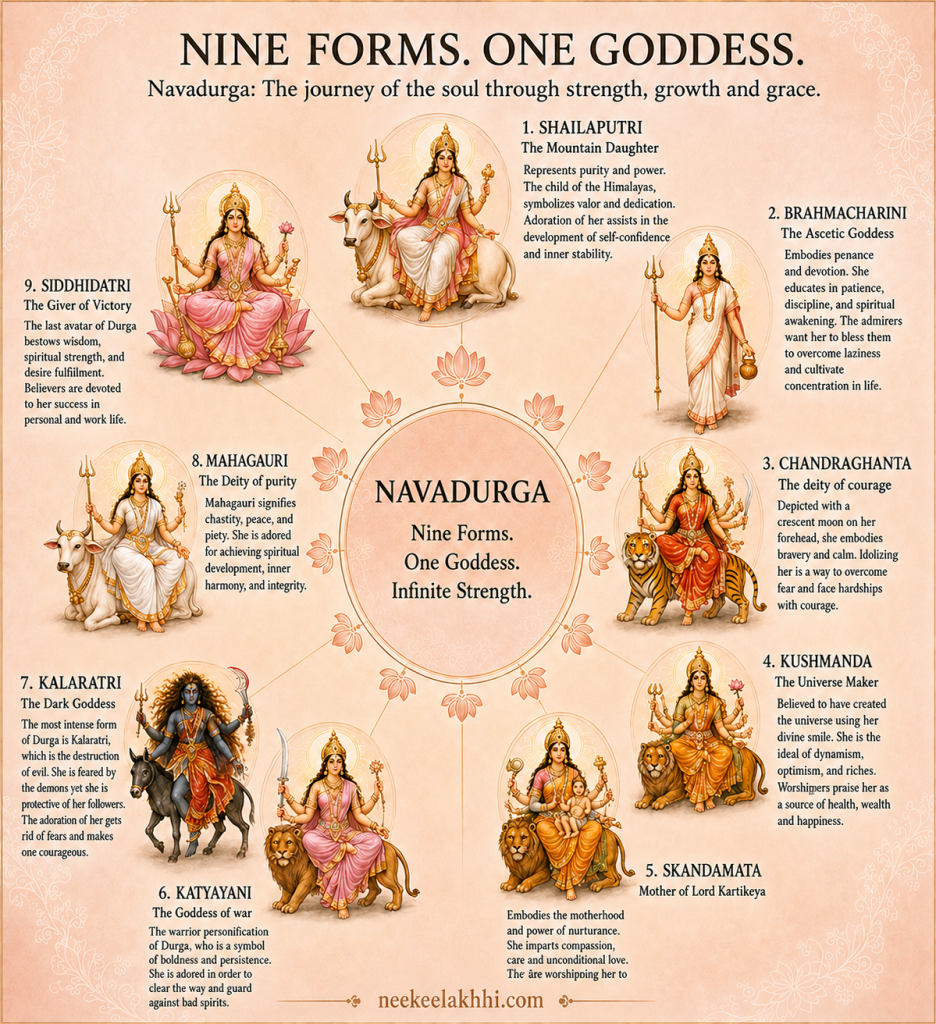
Nine Forms, One Goddess
Navaratri means “nine nights” in Sanskrit, and it’s one of the most widely celebrated festivals across India, though the way it’s honored shifts beautifully from region to region. At its heart, it’s a nine-night, ten-day devotion to the Divine Feminine, Shakti, and worship of her many forms. Each of the nine nights is dedicated to a different expression of the Goddess — the Navadurga — building toward Vijayadashami (or Dussehra), the tenth day that marks the triumph of light over darkness, of Durga’s victory over the demon Mahishasura.
One represents groundedness. Another discipline. Another fearless transformation. Another nurturing love. Together, they remind us that strength isn’t one-dimensional. Some seasons ask us to be soft. Others ask us to roar. Both are sacred.
Navaratri gives us nine nights to sit with all of her, which is really an invitation to sit with all of ourselves.
A Story That Still Feels Relevant
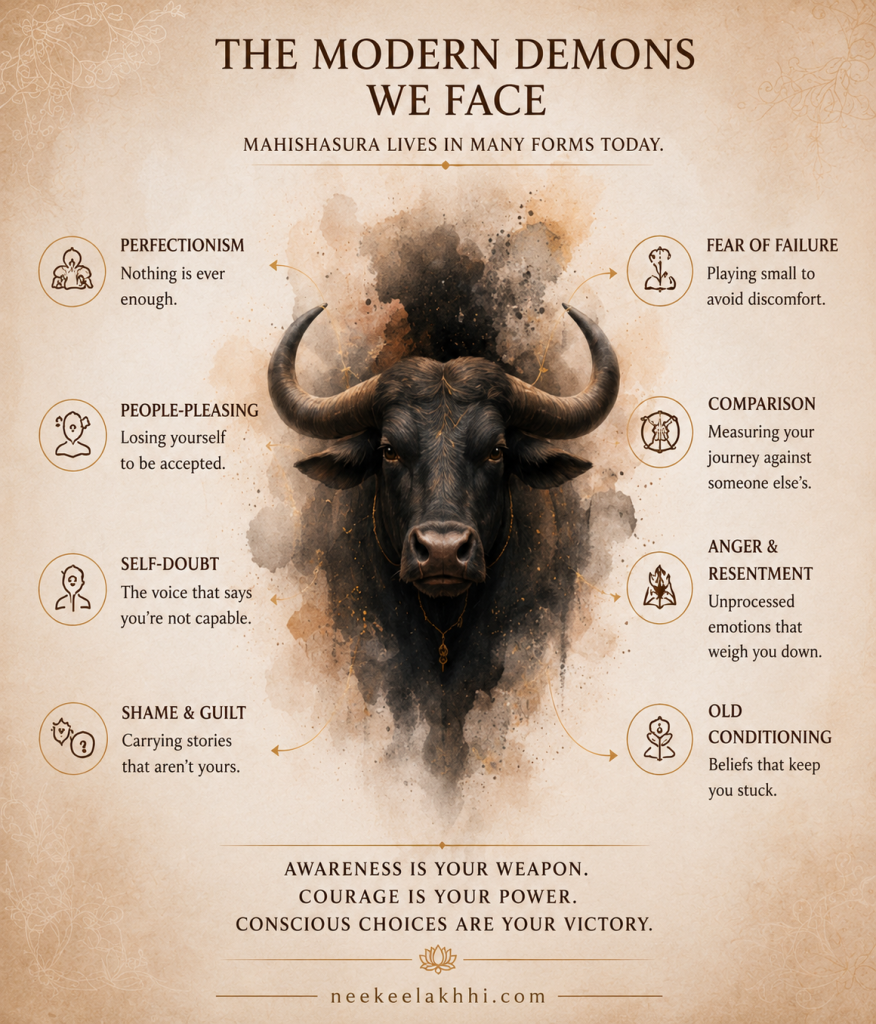
Most of us aren’t battling mythological demons today. Instead, we meet perfectionism, people-pleasing, fear of rejection, comparison, old conditioning and self-doubt. In many ways, these are our modern Mahishasuras.
What I love most is that Durga never looks frantic. Even in the middle of battle, her face is calm. To me, that’s what real power looks like—not reacting to everything around us, but staying deeply connected to ourselves.
And perhaps part of knowing your own power is understanding the responsibility that comes with it. Power isn’t something to misuse simply because we have it. The deeper wisdom is knowing when to use it, how to use it, and when not to use it at all.
Why This Name Matters to Me
I don’t know exactly what my teacher saw in me and perhaps that isn’t the point. Over time, NavaDurga has become less of a compliment and more of a compass. Whenever life feels uncertain, I quietly ask myself: Which expression of strength does this moment call for?
Sometimes the answer is courage. Sometimes it’s compassion. Sometimes it’s setting a boundary. Sometimes it’s resting instead of forcing. Every season asks something different of us.
Perhaps that’s why Durga has nine forms instead of one. None of us are meant to stay the same forever. Some seasons ask us to bloom like a lotus. Others ask us to roar like a lion. Wisdom is knowing which version of yourself the moment is calling forward.
I carry the name NavaDurga imperfectly, but gratefully. Whenever I forget who I am, she reminds me that everything I need has been within me all along.
One inner warrior at a time. 🏹
REFLECTION
- Which quality of Durga feels most alive in you today?
- What ‘weapon’—your courage, compassion, discernment or patience have you forgotten you already carry?
- Where might you need to stop fighting alone and allow yourself to receive support?
If something here shifted the way you look at things, I’d love to have you along for the journey. Join the newsletter for more honest reflections like this one and if you’re curious about working together or exploring the support I offer, you’re welcome to find out more.